
Core Banking Explained
What core banking is, how the software works, how it is built, who the leading providers are in India and where it is heading.
Channels
Branch · mobile · internet · ATM
Integration layer
Open interfaces and messaging
Core modules
Accounts · loans · payments · ledger
Data and reporting
Audit · analytics · compliance
Infrastructure
Cloud · on-premise · security
Core banking is the centralised system that processes a bank's daily transactions and updates customer accounts in real time across every branch and channel. Core banking software is the platform that runs accounts, deposits, loans, payments and the general ledger.
Core banking sits behind every deposit, loan and payment you make. Yet many banks, cooperative lenders and NBFCs still run on ageing systems that slow launches and raise costs. This guide explains core banking from the ground up: how it works, how it is built, which providers lead in India and how to evaluate one before you book a demo.
1
What is Core Banking?
2
Used by Banks in India
3
Providers
4
How it works
5
Architecture
6
Application Technology
7
Features & Benefits
8
Market Overview
9
Future
10
Book a Demo
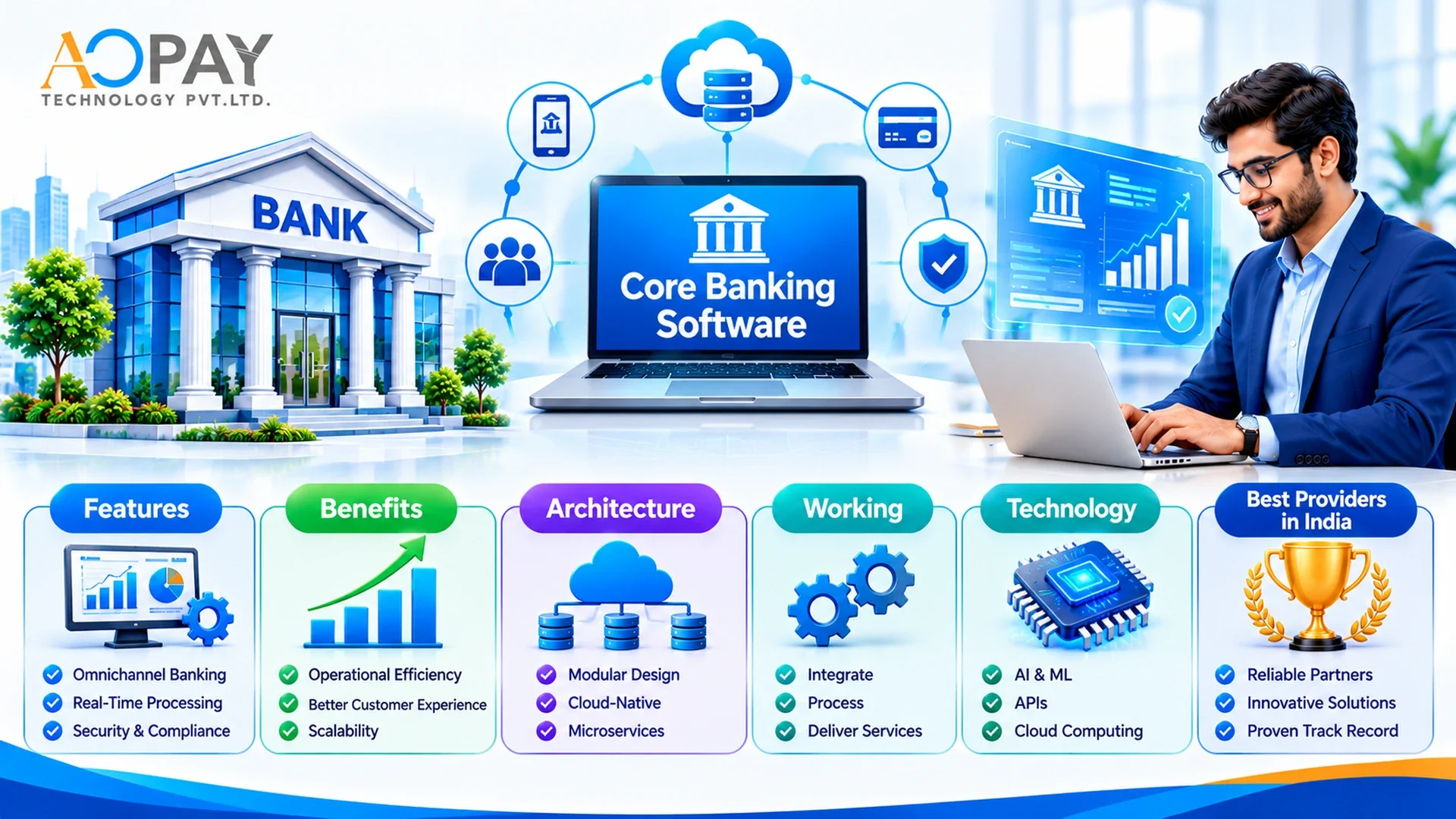
What Is Core Banking?
Core banking is a centralised, real-time banking system. When a customer deposits money at one branch, the balance updates instantly everywhere. That is what makes "anywhere banking" possible. The term is often expanded as Centralised Online Real-time Exchange.
What does core banking software do?
It manages customer records, savings and current accounts, fixed deposits, loans, payments and the general ledger from one platform, while enforcing compliance rules.
Core Banking Software Used by Banks in India
Large banks in India commonly run enterprise platforms from global and Indian vendors. Cooperative banks, credit societies, NBFCs and microfinance lenders often prefer modular, cost-aware platforms that match their size and regulation. Many are moving from ageing systems to modern core banking solutions to launch products faster.
Best Core Banking Software Providers in India
These providers appear in India and global market comparisons. We list AOPAY first because it is our own platform, and the rest alphabetically after it. Fit depends on size, regulation and budget, so always test with a demo.
AOPAY Technology: AOPAY BNexus
An all-in-one core banking solution for banks, cooperative banks, NBFCs, microfinance institutions, neobanks and digital wallet providers.
Account management, deposits, loans, payments and real-time transaction processing.
Cloud-based and on-premise deployment.
Multi-branch operations, transaction monitoring and compliance tooling.
Open integration with verification, payments and lending solutions.
| Provider | Known for |
|---|---|
| Finastra | Global banking software across retail and corporate segments. |
| Infosys Finacle | Enterprise core banking for large, complex institutions. |
| Oracle FLEXCUBE | Broad functionality for retail, corporate and international banks. |
| TCS BaNCS | Core banking, payments and wealth, with a strong Indian enterprise presence. |
| Temenos Transact | Large and international banks, with cloud-native and SaaS options. |
Running a lender rather than a bank? See AOPAY's NBFC software, loan management software and microfinance software.
How Does Core Banking Software Work?
1. Onboard. The customer is verified through KYC checks such as Aadhaar, PAN and bank account verification.
2. Open an account. A customer record and account are created with product rules.
3. Receive a request. A branch, app, ATM or payment channel sends a transaction.
4. Validate and post. The core checks balance and limits, then posts entries to the ledger in real time.
5. Run end-of-day processing. Interest, charges and reconciliations are calculated.
6. Report. Dashboards, audit trails and regulatory reports are produced.
Core Banking System Architecture
Channels
Branches, mobile and internet banking, ATMs, agents and payment rails. All channels use the same core, so every customer sees the same balance.
Integration Layer
Open interfaces and messaging connect the core to payment gateways, credit bureau reports and partners.
Core Modules
Customer information, accounts, deposits, loans, payments, general ledger, treasury and compliance modules process business rules in real time.
Data Layer
Transactional databases, audit logs and analytics stores keep records accurate, searchable and ready for regulators.
Infrastructure
Cloud, hybrid or on-premise hosting with encryption, access control, backup and high availability.
Core Banking Software Application Technology
| Technology | Why it matters |
|---|---|
| Modular, service-based design | Launch or change products without rebuilding the whole core. |
| Open integration interfaces | Connect payments, verification and lending quickly. |
| Event-driven messaging | Real-time updates across channels. |
| Containers and cloud-ready hosting | Scale with volume, deploy flexibly. |
| Role-based security and audit logs | Protect data and support compliance. |
Features and Benefits of Core Banking
Key Features
Customer and account management.
Deposits and loan processing.
Payments and settlements.
General ledger and treasury.
Multi-branch and multi-currency support.
Compliance and reporting.
Key Benefits
Real-time, anywhere banking.
Lower operating costs.
Stronger compliance and audit trails.
Better data for decisions.
Faster product launches.
Pair your core with e-mandate collections, payouts, virtual accounts, escrow accounts and a treasury management system for a complete stack.
Core Banking Software Market Overview
Estimates differ by research method. Most place the global core banking software market in roughly the USD 13 billion to 20 billion range for 2025, with forecasts of about 10% to 17% annual growth into the 2030s. Growth drivers include real-time payments, cloud adoption, regulatory change and the need to retire legacy cores. In India, cooperative banks, credit societies and NBFCs are modernising alongside large banks. Read about credit unions and NBFC collaboration and how NBFCs work.
Future of Core Banking Software
In Europe, open banking and instant payments under PSD2 and GDPR drive the same direction.
Pro tip: never choose on a brochure. Ask each vendor to demo your own scenarios, such as account opening, a loan disbursal and an end-of-day run.
Common Mistakes
Ignoring integration effort with payments and verification.
Underestimating data migration.
Skipping regulatory fit checks for your institution type.
Frequently Asked Questions
Core Banking Software Demo
A good demo proves the platform on your workflows. Ask to see:
In short: core banking is the foundation of every bank, and the right platform makes launches faster, compliance easier and operations cheaper.
Book Your AOPAY Core Banking Software Demo
See AOPAY BNexus handle accounts, loans, payments and reporting for your bank, cooperative, NBFC or microfinance institution.